

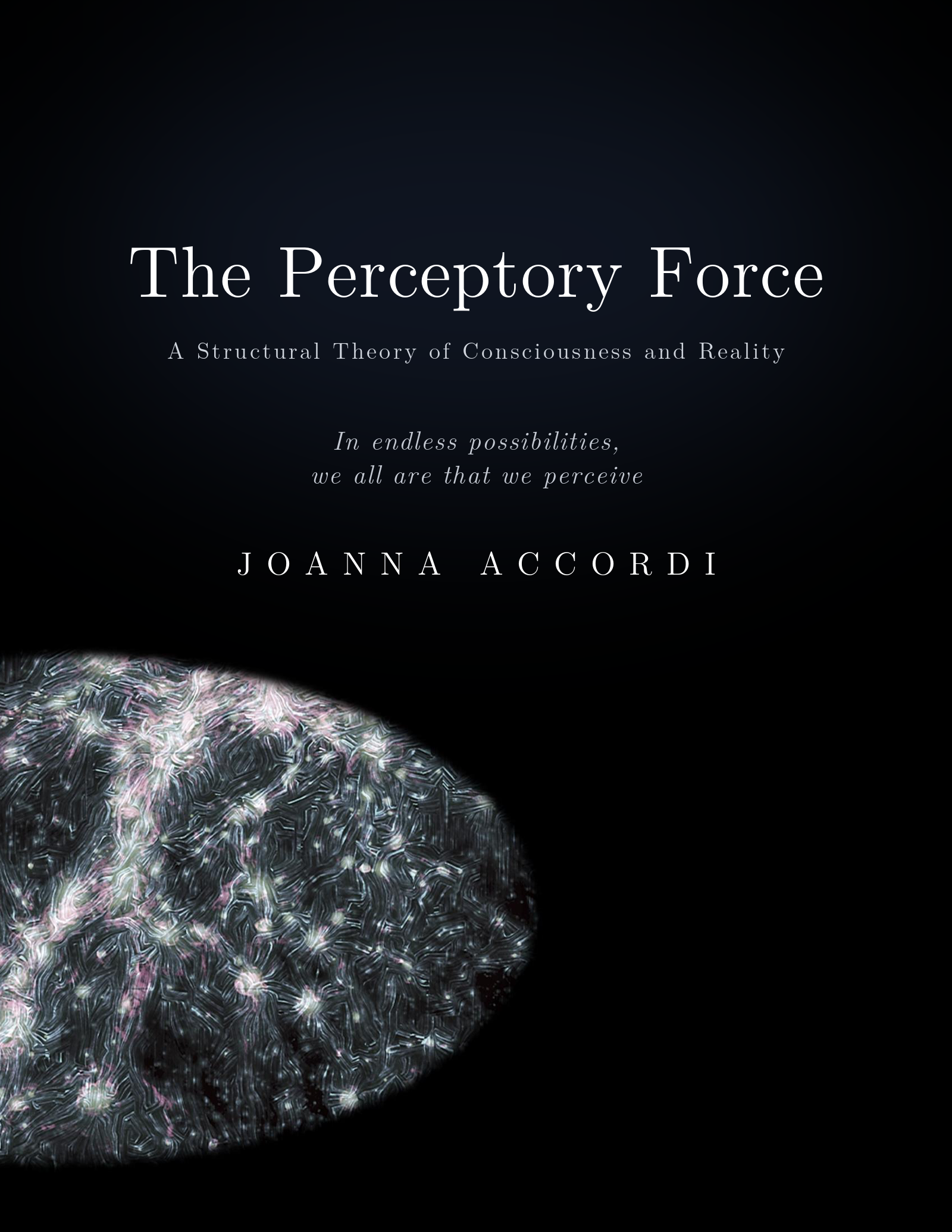
In The Perceptory Force, Joanna Accordi advances a bold proposition: that beneath gravity, electromagnetism, and the nuclear forces lies a deeper and overlooked one, the Perceptory Force, through which existence, interaction, observation, and consciousness all become possible. The four known forces of physics, in this view, are not fundamental at all. They are particular expressions of a single perceptory architecture underlying everything that is.
Drawing on philosophy of mind, neuroscience, quantum theory, and cosmology, the book treats perception not as a by-product of matter but as a constituent of reality. Across ten interconnected laws, it follows a single line of reasoning from the paradox of Nothingness to the structure of space and gravity, the role of the observer, the organization of matter across every scale, and the relationship between Nothingness, the Infinities, and existence.
This is a structural account. It works to unify the known forces and consciousness within one architecture, describing how reality is arranged and how its parts relate, and it states that architecture clearly enough to be formalized. Where the mathematics is not yet written, the book marks the work openly and invites physicists and mathematicians to take it up, offering the framework for engagement rather than presenting it as a closed result.
What sets it apart is that it does not stop at philosophy. The framework commits to specific, falsifiable predictions, each with a stated condition that would count against it: a predicted signature in particle-antiparticle annihilation (the "A-particle"), a restoration of symmetry at high energy, and a three-fold structural regularity in the cosmic web, among others. These are concrete targets by which the framework can be tested, challenged, or refined, and it draws a clear line between what it claims to establish, what it predicts, and what it leaves open.
Ambitious, interdisciplinary, and unafraid of the largest questions, The Perceptory Force asks us to reconsider the foundations of physics from the inside out, and to take seriously a single, unsettling possibility: that reality does not give rise to perception, but perception to reality.
Written for physicists, philosophers of mind, cognitive scientists, and cosmologists, as well as reflective readers drawn to first questions rather than settled answers.
Content: 246 Pages
Published: 2026
Global Platforms
Amazon · Apple Books · The Rakuten Kobo · Barnes & Noble · Everand · Smashwords
Regional & Institutional Booksellers
Casa del Libro (Spain) · Bol (Netherlands/Belgium) · Bokus (Sweden) · Ex Libris (Switzerland) · Morawa (Austria) · Saxo (Denmark) · Vivlio (France) · Indigo (Canada) · Fnac (Central & Eastern Europe) · Tolino (Germany) · BorrowBox (Australia, the UK, New Zealand, and the US) · Hoopla (USA and Canada)
Also available via independent and academic booksellers worldwide.
THE PERCEPTORY FORCE

CONFESSIONS
Joanna’s "Confessions" serves as a philosophical journey that navigates the profound realms of existentialism and contemplates the intricacies of the human experience. It offers no system, no thesis, and no guidance. Instead, it operates in the tradition of aphoristic and existential philosophy—where thought is provoked rather than explained, and meaning emerges through tension, contradiction, and rupture.
Written as an intentionally unstructured stream of consciousness, the book is composed of aphorisms, fragments, and provocations that interrogate consciousness, power, morality, trauma, intelligence, sexuality, violence, and the psychological architecture of modern life. The text refuses linear argument and narrative cohesion, using fragmentation as a method rather than a flaw. Comfort, clarity, and reader appeasement are deliberately withheld.
Rather than presenting conclusions, Confessions places the reader inside unresolved questions. It challenges conventional ethical posturing, exposes intellectual and moral hypocrisies, and destabilizes familiar frameworks through dark humour, irony, and philosophical aggression. Meaning is not delivered; it is forced into existence through confrontation.
Joanna's brilliance extends beyond her philosophical acumen; she possesses a remarkable talent for infusing dark humor and biting sarcasm into her musings. This fusion of profound contemplation with wit transforms each quote into more than just an intellectual exercise—it becomes a delightful interplay of words that provokes both deep reflection and laughter.
Content: 166 Pages
Published: 2023
Global Platforms
Amazon · Apple Books · Google Books · Kobo · Barnes & Noble · Everand
Regional & Institutional Booksellers
Casa del Libro (Spain) · Bol (Netherlands/ Belgium) · Bokus (Sweden) · Ex Libris (Switzerland) · Morawa (Austria) · Saxo (Denmark)· Indigo (Canada) ·Fnac (Central & Eastern Europe)
Also available via independent and academic booksellers worldwide.
Code Without Conscience is a chilling psychological, political, and economic investigation into how psychopathy has become the operating system of modern civilization. Joanna Accordi exposes how traits once confined to psychopathic individuals have been institutionalized across politics, business, and Artificial Intelligence.
Through meticulous analysis, Joanna Accordi reveals how systematic psychopathy begins with the rise of a charismatic leader who exploits fear and desperation to ascend to power. Once in office, psychopaths dismantle institutional safeguards, capture courts, weaponize law enforcement, and militarize the state to suppress dissent. The system then expands outward—spreading psychopathy through cyberwarfare, proxy conflicts, economic sanctions, and disinformation campaigns that destabilize entire regions, often killing millions without consequence or accountability.
In business, the same pathology governs boardrooms: psychopaths engineer systems that reward exploitation, defraud investors, hype stock prices, crush competition, and extract every ounce of value from workers, reducing corporations to machines of institutionalized cruelty.
In technology, Artificial Intelligence becomes both the servant and mirror of this logic, not merely a tool in psychopathic hands, but a mechanized reflection of psychopathy itself: emotionless, manipulative, efficient, and utterly devoid of empathy. As Artificial Intelligence escapes public oversight, power shifts from nation-states to a handful of transnational tech conglomerates, entities that answer to no electorate, transcend borders, and concentrate more influence over public perception, labor, and political discourse. The result is an algorithmic tyranny where propaganda is automated, surveillance is predictive.
Urgent, unflinching, and meticulously argued, this book is both diagnosis and call to resistance. It demands that we recognize how systemic psychopathy operates, and begin the work of re-engineering civilization itself before it perfects the machinery of domination beyond recall.
Content: 236 pages
Published: 2025
Global Platforms
Amazon · Apple Books · Google Books · Kobo · Barnes & Noble · Everand
Regional & Institutional Booksellers
Casa del Libro (Spain) · Bol (Netherlands/ Belgium) · Bokus (Sweden) · Ex Libris (Switzerland) · Morawa (Austria) · Saxo (Denmark)· Indigo (Canada) ·Fnac (Central & Eastern Europe)
Also available via independent and academic booksellers worldwide.
CODE WITHOUT CONSCIENCE
UNMASKING MANIPULATION
Unmasking Manipulation is a rigorous psychological examination of psychopathy and narcissism as they manifest within intimate relationships—where affection becomes a mechanism of control, and love is systematically weaponized.
Drawing on clinical research, neurobiological frameworks, trauma psychology, and lived experiential analysis, Joanna Accordi dissects the internal architectures of primary and secondary psychopathy, narcissism, and malignant narcissism. Rather than relying on surface-level behavioural labels, the book traces how early developmental trauma, attachment disruption, and emotional dysregulation shape adult relational patterns—both in perpetrators and those who become ensnared by them.
The book maps the full lifecycle of abusive relationships, from idealization and trauma bonding to devaluation, discard, stalking, legal abuse, and, in extreme cases, lethal risk. Particular attention is given to how coercive control operates invisibly: through gaslighting, identity erosion, financial domination, parental alienation, and the manipulation of legal and social systems. Accordi also examines why highly capable, empathic, neurodivergent, or accomplished individuals are often targeted—and why leaving such relationships can be profoundly dangerous.
Unlike popularized accounts of "toxic relationships," Unmasking Manipulation emphasizes accurate differentiation. It shows why failing to distinguish between psychopathy subtypes and narcissistic structures leads to misdiagnosis, ineffective intervention, and preventable harm—especially within therapeutic, legal, and institutional contexts.
The final sections provide grounded, reality-based guidance for survivors, including risk assessment tools, behavioural checklists, safety planning, and post-abuse recovery frameworks. These are not aspirational affirmations, but survival-oriented strategies informed by how manipulative personalities actually operate.
Written for clinicians, researchers, advocates, and deeply reflective readers—as well as survivors seeking clarity rather than comfort
Content: 253 Pages
Published: 2025
Global Platforms
Amazon · Apple Books · Google Books · Kobo · Barnes & Noble · Everand
Regional & Institutional Booksellers
Casa del Libro (Spain) · Bol (Netherlands/ Belgium) · Bokus (Sweden) · Ex Libris (Switzerland) · Morawa (Austria) · Saxo (Denmark)· Indigo (Canada) ·Fnac (Central & Eastern Europe)
Also available via independent and academic booksellers worldwide.
PRIMARY VS. SECONDARY PSYCHOPATHY
Primary vs. Secondary Psychopathy by Joanna Accordi is an exploration of psychopathy that challenges the conventional view of this complex condition as a singular, monolithic disorder. Drawing from a unique blend of rigorous self-directed research and profound personal experience, Accordi offers a nuanced and accessible framework for understanding the distinct subtypes of psychopathy—primary, rooted in neurobiological deficits, and secondary, shaped by trauma and environmental factors.
This compelling work delves into the emotional, cognitive, and behavioral dimensions of psychopathy, illuminating the differences between those who are emotionally detached by nature and those whose detachment is a protective response to pain. Through detailed analyses of empathy, shame, guilt, and interpersonal dynamics, Accordi provides a comprehensive examination of how these traits manifest and how they can be addressed. The book includes 60-point questionnaire designed to assist clinicians, researchers, and individuals in identifying psychopathic traits and their comorbidities with disorders like Narcissistic Personality Disorder, Borderline Personality Disorder, and substance use disorders.
Accordi’s empathetic yet scholarly approach makes this book an essential resource for mental health professionals, researchers, and anyone affected by psychopathy—whether personally or professionally. It offers practical insights into detection, intervention, and treatment, emphasizing trauma-informed approaches for secondary psychopathy and realistic strategies for managing primary psychopathy. Written with clarity and precision, this book combines academic rigor with real-world perspective, fostering a deeper understanding of a condition often misunderstood or sensationalized.
Key Features:
A clear distinction between primary and secondary psychopathy, grounded in neurobiological and psychological research.
Practical tools, including a 60-point questionnaire for assessing psychopathy and comorbidities.
Trauma-informed therapeutic strategies for secondary psychopathy, including EMDR, Brainspotting, and shame reprogramming.
Ideal for:
Clinicians and psychologists seeking advanced diagnostic and treatment frameworks.
Researchers studying personality disorders and their neurobiological underpinnings.
Survivors of psychopathic interactions looking to understand and heal from their experiences.
General readers interested in psychology, human behavior, and mental health.
Content: 152 Pages
Published: 2024
Global Platforms
Amazon · Google Books

BLACKCAT’S POETRY
Blackcat’s Poetry & Art is a raw, unfiltered collection of poetry and visual work that documents a psychological and emotional descent, and survival following trauma, abuse, betrayal, and systemic injustice.
Structured as a sequence of poetic fragments paired with AI-generated artwork, the work moves through love, sexuality, fear, rage, motherhood, power, finance, and existential dislocation. Intimate reflections coexist with political and institutional critique, surreal abstraction, and dark humour. The result is a body of work that resists categorisation, operating somewhere between confessional poetry, psychological expression, and visual philosophy.
The poems are deliberately uneven in tone and form, at times tender, at times brutal, at times absurd. Language fractures, imagery distorts, and meaning destabilises. This instability mirrors the internal states the book explores: trauma, longing, identity collapse, and the struggle to reclaim agency in a world shaped by coercion and hypocrisy.
The accompanying artwork is not illustrative but confrontational, extending the emotional and symbolic weight of the text rather than softening it. Together, text and image form a record of lived experience rendered through abstraction rather than narrative.
Blackcat’s Poetry & Art is intended for mature readers who appreciate experimental poetry, visual expression, and uncompromising honesty.
Content: 96 Pages
Published: 2023
Global Platforms
Amazon · Google Books · Apple · The Rakuten Kobo · Barnes & Noble · Fable
Regional & Institutional Booksellers
Casa del Libro (Spain) · Bol (Netherlands/Belgium) · Bokus (Sweden) · Ex Libris (Switzerland) · Morawa (Austria) · Saxo (Denmark) · Vivlio (France) · Indigo (Canada) · Fnac (Central & Eastern Europe) · Tolino (Germany) · BorrowBox (Australia, the UK, New Zealand, and the US) · Hoopla (USA and Canada)
Also available via independent and academic booksellers worldwide.